
Yacht Surveying 1

Welcome to the Course!
Welcome to Yacht Surveying 1, the first course in a two-part series dedicated to yacht surveying.
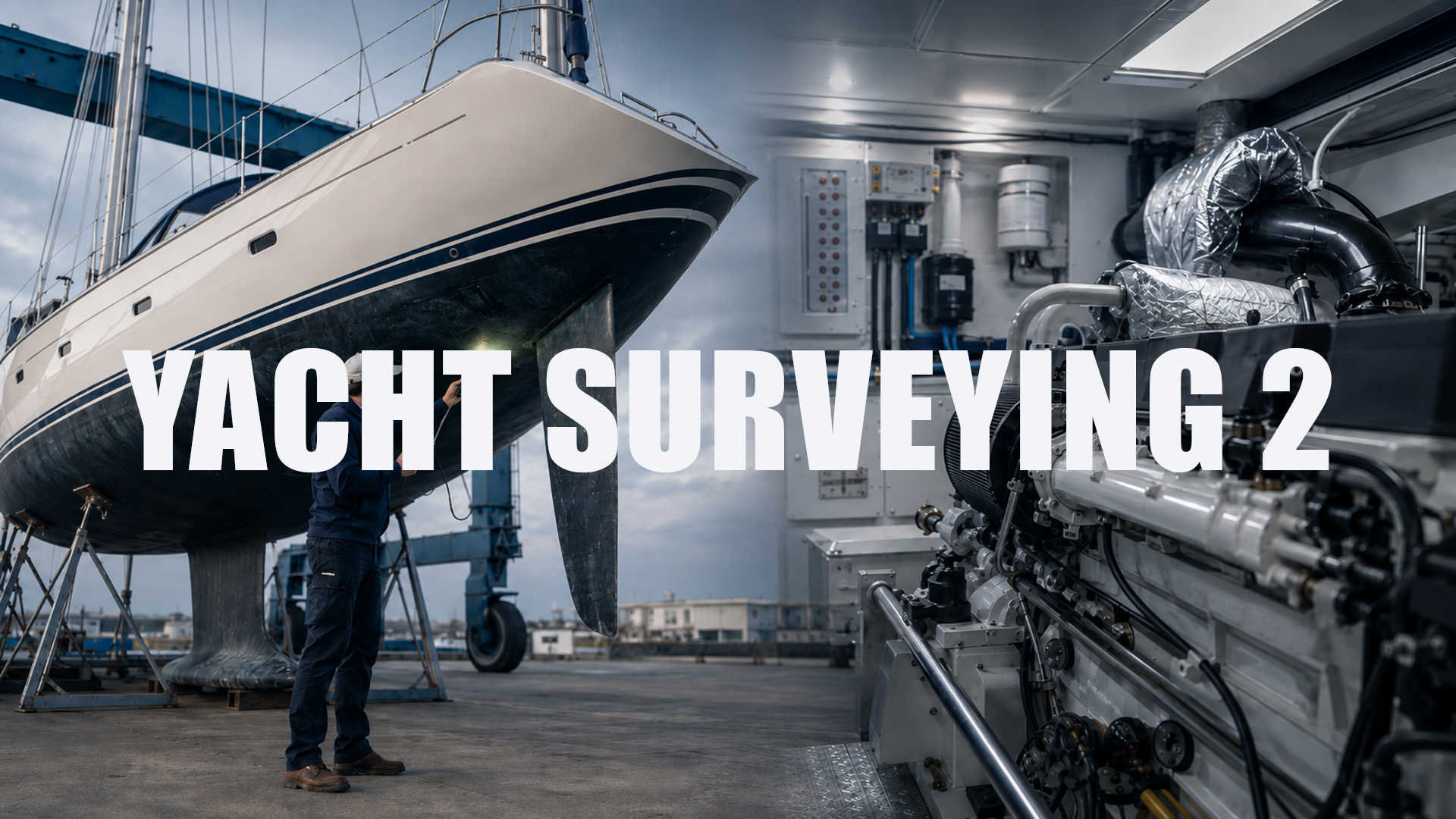
Yacht surveying is a practical, detailed, and highly responsible activity. A surveyor may be asked to inspect a yacht before purchase, assess its condition for insurance purposes, investigate damage after an incident, evaluate rigging and sails, support a valuation, or observe the yacht’s performance during a sea trial. In every case, the surveyor acts on behalf of a client and must observe carefully, record accurately, and report facts clearly.
In this course, you will be introduced to the world of yacht surveying from both the practical and regulatory sides. You will learn why surveying is not only about inspecting a boat on site, but also about understanding the rules, organizations, technical standards, materials, safety issues, client instructions, and reporting responsibilities that influence the surveyor’s work.
Whether you are passionate about boats, considering a career in marine surveying, working in the yacht industry, or simply interested in understanding how yachts are inspected and assessed, this course will help you take your first structured step into the yacht surveying world.


Course Overview
Yacht Surveying 1 provides a practical introduction to the work of a yacht surveyor. The course is organized into four main sections.
The first section, Introduction and Regulatory Matters, introduces the organizations and regulatory structures that influence yachts and small craft. Students will learn about the role of Flag States, Classification Societies, Certifying Authorities, and other professional organizations in the marine industry. The course also explains how rules, regulations, statutory requirements, voluntary standards, and certification systems may affect yachts, owners, and surveyors.
The second section, Types of Surveys, examines the main types of yacht surveys a surveyor may be requested to perform. These include pre-purchase surveys, condition or insurance-related surveys, damage surveys, rig and sails surveys, valuation surveys, and sea trials. Students will learn the purpose of each survey type, who may request it, what the surveyor is expected to observe, and why the final report can have significant practical, financial, or legal importance.
The third section, Surveying Crafts of Different Construction Materials, introduces the main materials used in boatbuilding and the specific issues that may arise when inspecting different types of craft. Students will explore how construction material affects the survey approach, what kinds of defects or deterioration may be relevant, and why the surveyor must adapt the inspection method to the boat being surveyed.
The final section, The Survey Process, takes students through the practical stages of carrying out a survey. This includes receiving instructions, preparing for the appointment, considering safety on site, using appropriate tools, inspecting the yacht in a logical and systematic way, recording findings, taking photographs, reviewing documentation, and preparing the final report for the client.
Throughout the course, students are encouraged to think like a surveyor: carefully, objectively, practically, and with attention to detail.
What You Will Learn
By the end of this course, students will have a general understanding of the yacht surveying profession, the main organizations and regulations that shape the industry, the most common survey types, and the practical steps involved in preparing, performing, and reporting a yacht survey.
More concretely, students will learn to:
- Understand the role of the yacht surveyor and the importance of acting on behalf of the client.
- Recognize why surveyors must report facts clearly and avoid unsupported assumptions.
- Understand the role of Flag States in yacht registration, safety requirements, and regulatory compliance.
- Understand the role of Classification Societies and how they relate to technical standards, class rules, and statutory certification.
- Understand the role of Certifying Authorities and professional organizations involved in yacht and small craft compliance.
- Identify how rules, regulations, voluntary standards, and statutory requirements may affect yachts and survey work.
- Distinguish between different types of yacht surveys, including pre-purchase, condition, damage, rig and sails, valuation, and sea trial surveys.
- Understand the purpose and scope of a pre-purchase survey and why it is often one of the most comprehensive survey types.
- Understand how condition surveys may be used for insurance, loss prevention, or pre-entry purposes.
- Understand the purpose of damage surveys, including the assessment of the nature, cause, extent, and possible repair implications of damage.
- Understand the specific considerations involved in rig and sails surveys for sailing yachts.
- Understand the purpose of valuation surveys and the importance of supporting valuation opinions with evidence.
- Understand the purpose of sea trials and how they help assess the operational performance of a yacht.
- Recognize the main construction materials used in boatbuilding and how they influence the survey approach.
- Understand the importance of inspecting hulls, coatings, structural elements, equipment, machinery, steering, documentation, and onboard systems.
- Learn how safety considerations affect the surveyor’s work on site, especially around machinery, equipment, boatyards, and other hazards.
- Understand the importance of survey preparation, client instructions, tools, photographs, notes, and clear reporting.
- Gain a practical foundation for continuing into more advanced yacht surveying topics in the second part of the series.
Course Organization
The course is video-based and on-demand, allowing you to learn at your own pace, wherever and whenever you want.
It includes videos, quizzes, and downloadable documents, and provides access to the course’s virtual private classroom, where you can interact with the instructor and other students.
Upon completion of the course, you will receive a Course Certificate. To obtain the Course Certificate, you must complete all lessons, pass the quizzes, and have your Course Assignment approved.
– Resources:
- Video lessons.
- Subtitles: English, Español, Français, Italiano.
- Downloadable materials.
- Quizzes.
- Final Assignment.
- Virtual Private Classroom.
- Course Certificate.
– Classroom:
– Prerequisites:
- To follow the course, no prior knowledge of Yacht Surveying is required.
- A minimum Navalapp membership level of “Subscriber” (free membership) is required to enroll in this course.
Course Content
The course
The Instructor


Course Includes
- 33 Lessons
- Subtitles: English, Español, Français, Italiano.
- Written documentation
- 27 Quizzes
- Final Assignment
- Course Evaluation Survey
- Virtual Private Classroom
- Course Certificate