


Yacht Design 1


Early Access!
Almost 70% of the course content is currently available, and we plan to end the Early Access period at the beginning of next week. All lessons listed below whose titles do not include “(soon)” already have their videos available.
The Early Access to our new Yacht Design 1 course is now officially open.
Early Access gives you the opportunity to enroll in this course before its official release, at a special discounted price available only during this period. You can begin working through the available course material right away while we continue finalizing and publishing the remaining lessons and resources.
Once the Early Access period ends, the course will be released in its complete form and offered at its final price. By enrolling during Early Access, you secure your enrollment at the discounted rate.
Welcome!
Welcome to Yacht Design 1!
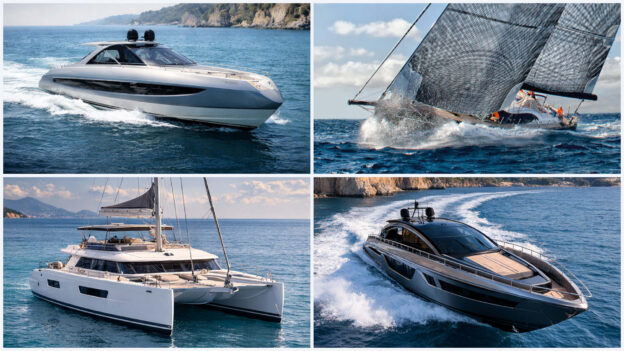
In this course, you’ll explore what makes a yacht perform the way it does, and how design choices in geometry and proportions affect stability, speed, handling, and seakeeping. Step by step, you’ll follow a practical concept-design workflow, from defining main dimensions and ratios to making first estimates for key parameters such as speed targets, center of gravity, and minimum stability. Along the way, you’ll model hull forms and design appendages like rudders, keels (with bulb), and foils, and learn the essentials of sails and rig for sailing yachts.
Let’s get started!
The Course
This course is designed as the first of a two-course series covering the broad topic of yacht design for both sailing and motor yachts. Across the two courses, students will learn the basic concepts required to design a yacht and develop the practical skills needed to carry out the design through detailed case studies, primarily using Maxsurf software.
Together, the courses cover several of the most important aspects of the concept design stage and serve as an introduction to the knowledge required for the yacht design process. This first course focuses on the theoretical foundations and the design stages of the hull, appendages, and rig. To put this knowledge into practice, students will model different types of yachts. In the second course, additional elements needed to complete the design process will be addressed, including onboard elements, structural design, and equipment (to a limited extent), as well as stability, resistance, seakeeping, and VPP calculations.
More precisely, this course focuses on the following topics:
- Basic notions of the yacht design methodology: stages, key considerations, and relevant milestones.
- Key yacht properties (e.g., stability, performance/speed, and seakeeping) and their relationship to the yacht’s geometric characteristics.
- Hull, appendage, and rig characteristics. Appendages include rudders, keels, and foils.
- Preliminary decisions on main dimensions and initial estimates of critical parameters such as speed, center of gravity position, minimum required stability, etc.
- Design of the hull, appendages (rudder, keel, and foils), and rig using Maxsurf Modeler, together with supplementary basic tools.
In the continuation course, further topics in yacht design will be covered, including:
- Hull resistance calculations, focusing mainly on systematic series and Maxsurf Resistance, and also covering semi-analytical methods such as Savitsky (planing hulls) and slender-body methods (multihulls).
- Stability calculations using Maxsurf Stability.
- Motions and added resistance in waves using Maxsurf Motions.
- Polar curves and sailing-yacht performance calculations using Maxsurf VPP.
What will you learn?
By the end of the course, the student will be able to understand the relationship between a yacht’s properties and its main characteristics, dimensions, ratios, and key parameters for both sailing and motor yachts. In addition, the student will have learned how to design a yacht’s hull and appendages—such as the rudder, keel (including bulb), and foils—using Maxsurf.
More specifically, by the end of the course, the student will be able to:
- Understand the stages and development of the yacht design process.
- Distinguish between different types of yachts by understanding differences in their main features.
- Understand the main characteristics of a yacht, including stability, speed, maneuverability, seakeeping, and (for sailing yachts) the ability to sail close-hauled.
- Understand the main geometric components of a yacht (hull, appendages, and sails) and their relevance to performance and overall behavior.
- Understand the relationship between the required yacht characteristics and the design decisions regarding the main elements, such as the hull, appendages, and sails.
- Determine the main dimensions and ratios of a yacht based on design specifications and requirements.
- Design a yacht hull using Maxsurf Modeler.
- Design different appendages using Maxsurf Modeler.
- Determine the main dimensions and characteristics of sails and rig for a sailing yacht.
Software License
Navalapp Members enrolled in one or more Courses may be eligible for free access to Maxsurf, subject to specific conditions. Click here to review the eligibility criteria.
Course organization
The course is video-based and on-demand, allowing you to learn at your own pace, wherever and whenever you want.
It includes videos, quizzes, and downloadable materials, plus access to the course’s private virtual classroom, where you can interact with the instructor and other students.
After you complete all lessons, pass the quizzes, and have your final assignment approved, you’ll receive a Course Certificate.
– Resources:
- Video lessons.
- Subtitles: English, Español, Français.
- Downloadable materials.
- Quizzes.
- Final Assignment.
- Virtual Private Classroom.
- Course Certificate.
– Classroom:
– Prerequisites:
- The course is designed so that any student with no prior knowledge of naval architecture can follow the lessons and understand the basic concepts. Nonetheless, a technical or engineering background is strongly advised. Naturally, prior knowledge of naval architecture will make it easier to follow the material. In any case, most of the basic principles of naval architecture are discussed in a collection of articles publicly available on the Navalapp website: https://navalapp.com/articles/
- To enroll in this course, you must have at least a Navalapp “Subscriber” membership (free).
Course Content
Introduction


Course Includes
- 66 Lessons
- Subtitles: English, Español, Français
- Downloadable materials
- 45 Quizzes
- Final Assignment (Capstone Project)
- Course Evaluation Survey
- Virtual Private Classroom
- Course Certificate